


DPIFS

Close

Vaswani Chambers, 1st Floor, 264–265, Dr. Annie Besant Road, Municipal Colony, Worli,
Mumbai – 400025

+91 97699 97166

info@dpifss.com

Contacts

Vaswani Chambers, 1st Floor, 264–265, Dr. Annie Besant Road, Municipal Colony, Worli,
Mumbai – 400025

AI Surveillance & Event Recognition System

Artificial Intelligence

Brief and project description

The AI Surveillance & Event Recognition System is a comprehensive video analytics platform designed to provide continuous, intelligent monitoring of urban environments. By combining edge-based AI processing at camera level with centralized analytics engines, the system ensures low-latency detection, high processing efficiency, and scalable deployment across cities. It goes beyond passive CCTV monitoring by transforming video feeds into structured, actionable intelligence for traffic authorities, municipal corporations, and command-and-control centers.

The platform automatically identifies predefined events based on configured detection models. Once an event is detected, the system instantly tags the incident with timestamp, GPS location (if integrated), and camera ID. It generates evidence snapshots and short video clips for validation, archival, and enforcement workflows. Through live dashboards integrated into city command centers, authorities receive real-time alerts, enabling rapid response and coordinated action.
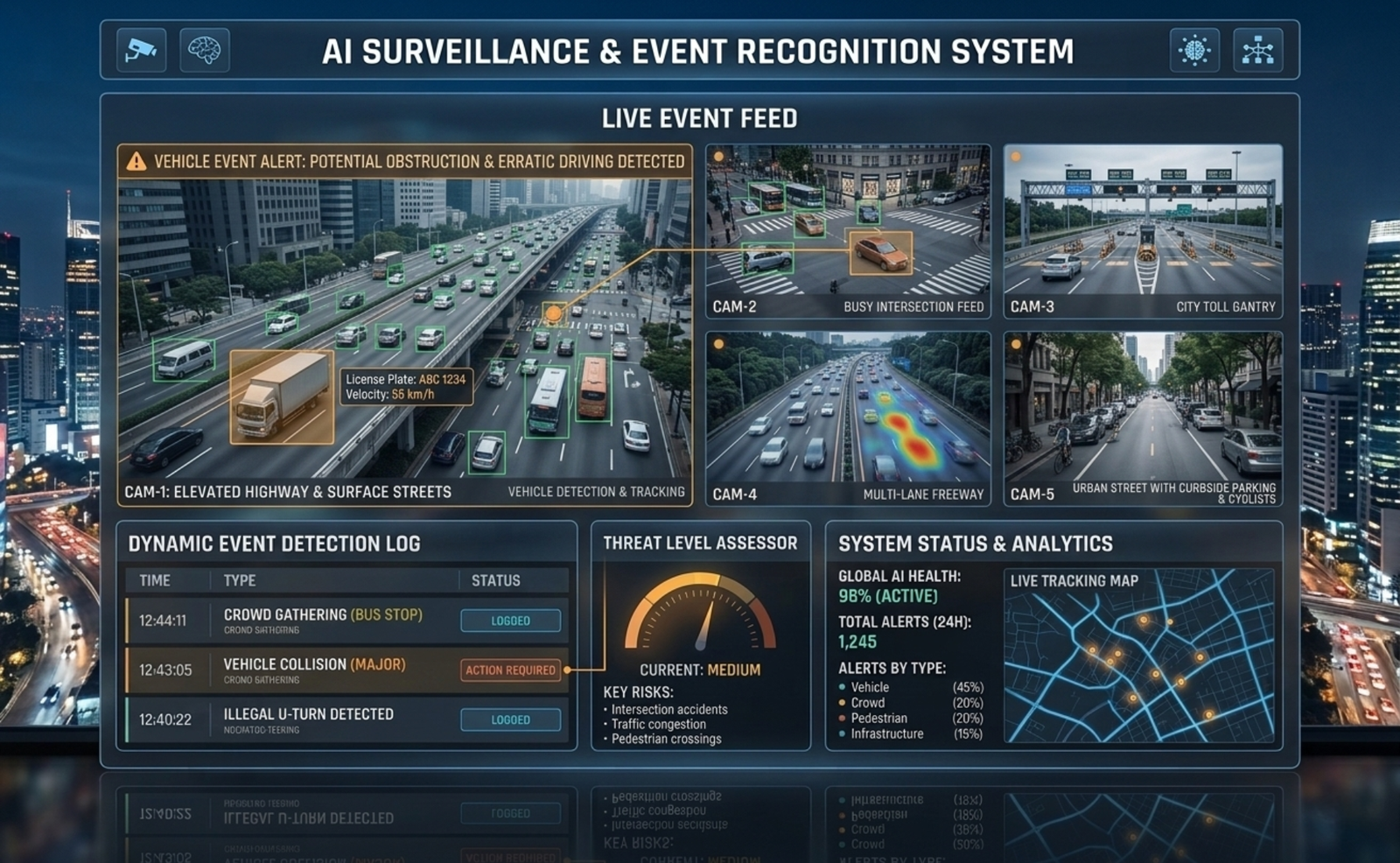
 

Recognised Events (Configurable Intelligence)

The system can be configured to detect and classify multiple urban risk scenarios, including:

  • Accidents and vehicle collisions
  • Wrong-way vehicle movement
  • Stopped or abandoned vehicles
  • Pedestrian risk events near crossings or intersections
  • Congestion build-up and abnormal traffic flow patterns

Because the models are configurable, the solution can be adapted for highways, urban intersections, toll plazas, or high-density public zones.

Why This System is Critical in the Indian Context

India has one of the highest road accident burdens globally. According to data published by the Ministry of Road Transport and Highways, India records over 4.5 lakh road accidents annually, resulting in more than 1.5 lakh fatalities each year. A significant percentage of these incidents occur at intersections and high-density urban corridors where delayed response and lack of monitoring contribute to severity.

Additional urban mobility realities in India:

  • Rapid vehicle growth in Tier 1 and Tier 2 cities has significantly increased congestion density.
  • Manual CCTV monitoring suffers from human fatigue, operators can lose attention within 20–30 minutes of continuous observation.
  • Incident response delays often worsen traffic pile-ups and increase secondary accident risk.

AI-powered event recognition directly addresses these gaps by enabling:

  1. Early Incident Detection – Immediate alerting can reduce emergency response time significantly, improving survival rates in accident scenarios.
  2. Congestion Mitigation – Real-time congestion alerts allow traffic police to implement diversions before gridlock escalates.
  3. Improved Enforcement & Evidence Integrity – Automated tagging reduces subjectivity and improves transparency.
  4. Data-Driven Urban Planning – Aggregated analytics provide insights into black spots, peak-risk zones, and behavioral trends.

Strategic Importance for Smart Cities

In the Smart City framework, surveillance must evolve from reactive monitoring to predictive intelligence. AI-enabled analytics convert existing CCTV infrastructure into a proactive urban risk management system. This enhances:

  • Public safety
  • Traffic efficiency
  • Law enforcement effectiveness
  • Administrative transparency

When integrated with intelligent traffic systems and BOT-based deployment models, the platform becomes financially sustainable while strengthening governance capabilities, enabling cities to move toward safer, data-driven, and resilient infrastructure ecosystems.

Recognised Events (Configurable Intelligence)

The system can be configured to detect and classify multiple urban risk scenarios, including:

  • Accidents and vehicle collisions
  • Wrong-way vehicle movement
  • Stopped or abandoned vehicles
  • Pedestrian risk events near crossings or intersections
  • Congestion build-up and abnormal traffic flow patterns

Because the models are configurable, the solution can be adapted for highways, urban intersections, toll plazas, or high-density public zones.

From a behavioral perspective, signal waiting time presents a uniquely captive attention environment. Urban traffic studies indicate that average red-light waiting times range between 45 to 120 seconds in major city intersections. Research in out-of-home (OOH) advertising suggests that stationary audiences demonstrate 2–3x higher message recall rates compared to audiences exposed to content while in motion. Additionally, digital screen engagement during paused moments can achieve up to 85% visual attention capture, particularly when placed within direct driver sightlines.

This makes STTS an exceptionally effective platform for:

  • Government advisories and emergency alerts
  • Public health announcements and civic campaigns
  • Traffic safety awareness messaging
  • Real-time city updates
  • Strategically placed advertisements

By combining intelligent activation logic with behavioral attention science, STTS transforms traffic junctions into compliant, high-impact communication nodes. It enhances public information dissemination while simultaneously unlocking monetization opportunities under BOT-based smart infrastructure models, without compromising safety or requiring upfront government capital expenditure.

Artificial Intelligence involves creating computer systems capable of performing tasks that usually require human intelligence. This includes developing algorithms and models that allow machines to learn, reason, and perceive effectively.Adam Peterson