


DPIFS

Close

Vaswani Chambers, 1st Floor, 264–265, Dr. Annie Besant Road, Municipal Colony, Worli,
Mumbai – 400025

+91 97699 97166

info@dpifss.com

Contacts

Vaswani Chambers, 1st Floor, 264–265, Dr. Annie Besant Road, Municipal Colony, Worli,
Mumbai – 400025

AI-Based Traffic Violation Detection System

Artificial Intelligence

Brief and Solution description

The AI-Based Traffic Violation Detection System is an end-to-end automated enforcement platform built to enhance road discipline through precision-driven monitoring and legally admissible digital evidence management. Designed for modern traffic ecosystems, the system leverages advanced computer vision, deep learning algorithms, and Automatic Number Plate Recognition (ANPR) to detect, classify, and document traffic violations in real time, without manual intervention.

High-resolution cameras combined with AI models continuously monitor intersections, highways, and urban corridors. Once a violation is detected, the system automatically captures time-stamped photographic and video evidence, reads and verifies the vehicle registration number, and categorizes the offense through an intelligent violation classification engine. Each case is stored with tamper-proof audit logs, ensuring evidentiary integrity and compliance with enforcement protocols. The platform is fully integration-ready with state transport databases and e-challan systems, enabling seamless issuance of digital penalties and transparent enforcement workflows.
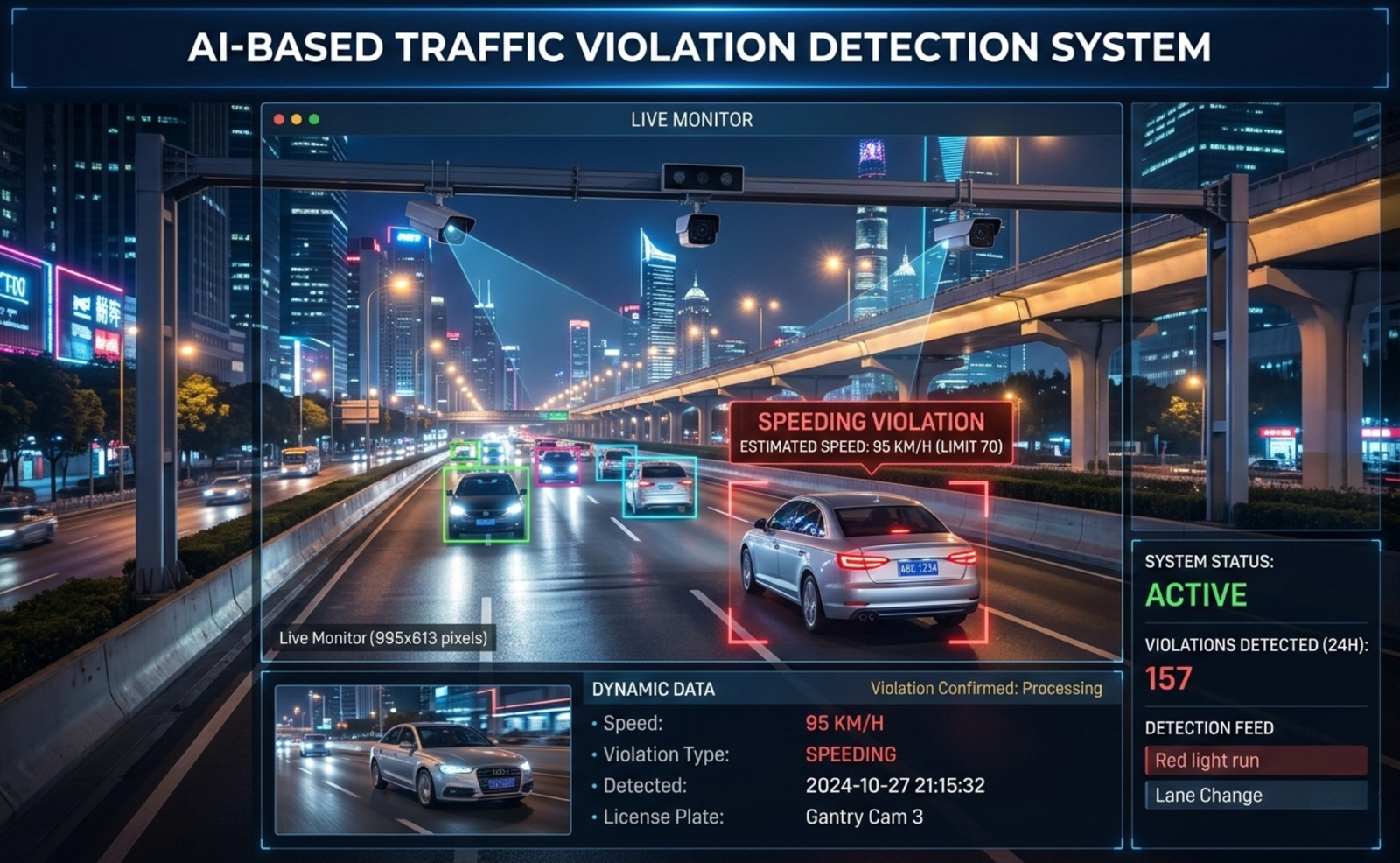
 

Detected Violations

The system can automatically identify and record:

  • Red-light jumping
  • Overspeeding
  • Lane discipline violations
  • No-helmet detection
  • No-seatbelt detection
  • Wrong-way driving
  • Illegal parking
  • Stop-line crossing

Because the AI models are configurable, the platform can be adapted to city-specific enforcement priorities and regulatory frameworks.

Importance in the Indian Context

India faces significant challenges in road safety and compliance. According to the Ministry of Road Transport and Highways, the country reports over 4.5 lakh road accidents annually, leading to more than 1.5 lakh fatalities. A substantial proportion of these accidents are linked to speeding, signal violations, and non-compliance with helmet and seatbelt laws.

Key contextual realities:

  • Overspeeding contributes to a majority of fatal road accidents in India.
  • Helmet and seatbelt non-compliance remains a leading factor in preventable deaths.
  • Manual enforcement is resource-intensive and prone to inconsistencies.

Automated AI-based enforcement systems directly address these gaps by ensuring:

  1. Consistent and Bias-Free Enforcement – AI eliminates selective or manual subjectivity.
  2. Higher Compliance Rates – Digital enforcement with clear evidence increases deterrence.
  3. Reduced Corruption and Disputes – Tamper-proof digital records enhance transparency.

Faster Processing & Revenue Realization – Seamless integration with e-challan systems accelerates fine issuance and recovery.

Strategic Value for Smart Cities

In a rapidly motorizing nation, enforcement must scale with vehicle growth. AI-driven violation detection transforms static monitoring infrastructure into an intelligent compliance ecosystem. It strengthens governance, improves road safety outcomes, and builds a data repository for policy planning, identifying accident-prone zones, recurring violations, and behavioral trends.

When deployed under BOT-based smart infrastructure models, the system not only enhances public safety but also creates a financially sustainable enforcement framework, requiring no upfront government capital expenditure while delivering measurable improvements in compliance, transparency, and urban mobility discipline.